


Chicken Road Mechanics — Rules, Multipliers and Cash Out
The mechanics of Chicken Road are built on a sequence of decisions. The player picks a bet and a difficulty, then guides the chicken across separate sections of the road. A successful step unlocks a higher multiplier; a failed one ends the round with no payout. After a successful crossing you can stop and take the current amount or risk it for the next multiplier.
Here we look at the original Chicken Road by InOut Games, released on 4 April 2024, not Chicken Road 2.0 or other sequels. The developer officially states an RTP of 98% and four modes: Easy, Medium, Hard and Hardcore. Below we separately mark the characteristics confirmed by the provider and a multiplier table published by third-party researchers after testing a specific demo version. Before playing, check the numbers against the rules in your game window.
chickenroad.net.ua is an information website: it does not accept bets, run real-money games or hold visitors’ funds. We are not a gambling operator and have no affiliation with InOut Games. Real-money play is only for people aged 21 and over, and only with operators holding a valid licence in Ukraine.
How the Chicken Road mechanics work
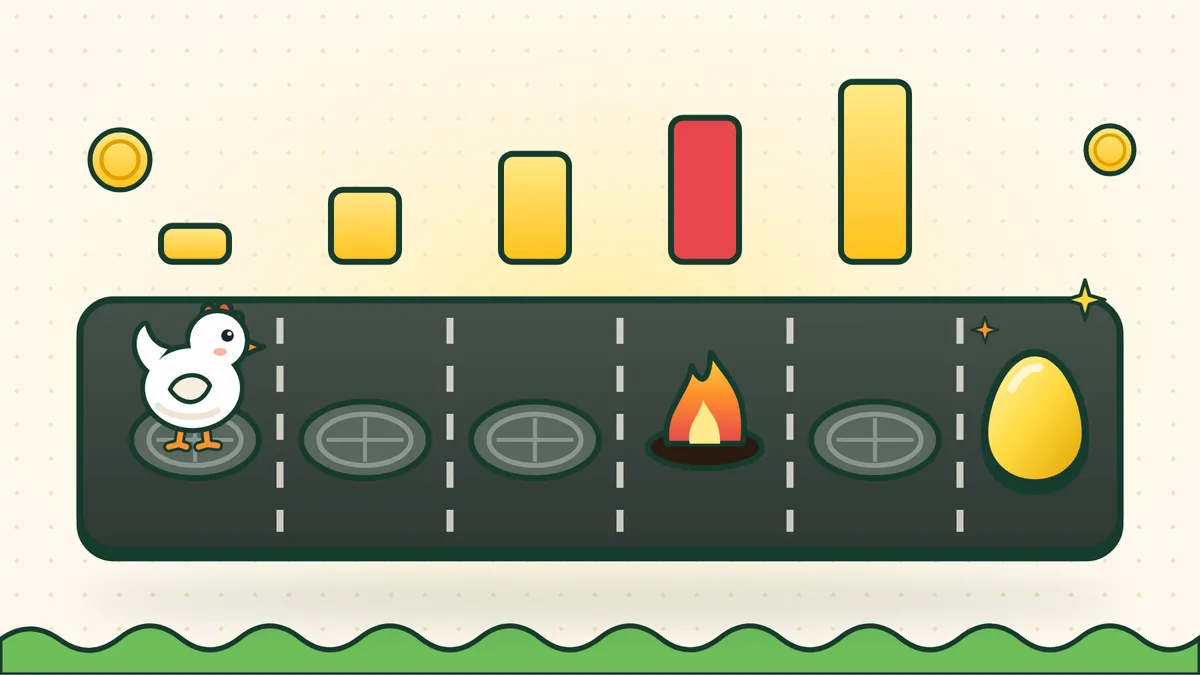
What happens on each step
A round of Chicken Road is nothing like a spin on a classic slot: once the bet is placed, the player sees a route of consecutive sections with their multiplier values. The chicken starts in front of the first section. Each next step is a new attempt to continue the same round, not a new separate bet.
- Before the start, you set the bet amount and one of the four modes.
- Once the round is launched, the chicken tries to cross the next section of the road.
- If the crossing succeeds, that section's multiplier becomes available; the player can end the round or continue.
- If the player continues, they give up the guaranteed finish at the current multiplier and accept the risk of the next step.
- The round ends with a payout after Cash Out or with a loss after a failed crossing.
An important detail: multipliers do not add up. Three successful steps do not pay three separate prizes. The payout is calculated at the multiplier of the section where the player chose to end the round.
When a round ends in a win or a loss
After a successful step, the amount shown is a potential payout that can be locked in with the Cash Out action. Until the round ends, it remains at risk. If the next crossing fails, the earlier successes do not return any part of the bet: the result of that round is zero.
| Event | What changes | How it ends |
|---|---|---|
| Successful step | The next multiplier is unlocked | The round continues; the payout is not yet locked in |
| Cash Out | The multiplier reached is locked in | The round is over and the payout is calculated |
| Failed step | The previous multiplier can no longer be collected | The bet for the current round is lost |
| Crossing the last section | The end point of the route is reached | The payout is determined by the rules and limit of the specific version |
Bets and round control in Chicken Road
How the bet is set before the start
First you set the cost of one attempt. This is the amount you can lose entirely if the chicken fails to cross the next section before the round ends. Then you choose the difficulty and start the game. For a new round, the bet and mode can be set again.
Do not confuse the bet, the deposit and the maximum payout. The bet is the amount in play in the current round; the deposit is the money credited to the operator balance; the maximum payout is a separate limit on the amount that can be credited as a result. The provider's public description does not set a universal bet range for all platforms. In our demo, all operations use a virtual balance.
How the Go and Cash Out buttons work
The Go button, if that is how it is labelled in the implementation, means an attempt to cross the next section. Cash Out, Collect or another button with the same meaning stops further steps and locks in the multiplier reached. Some versions of the game interface have a separate Play button to start the round or allow stepping forward with the space bar.
These are different actions with different consequences: Go increases the available multiplier only if it succeeds, while Cash Out gives up future multipliers in exchange for the payout already available. The speed at which you press the buttons should not be seen as a way to get a better random outcome.
What happens to the bet after a failed crossing
If the chicken has crossed several sections but then lands on a dangerous one, the bet for that round is lost in full. For example, if after two successful steps a multiplier of ×1.28 was already available, but the player chose to take a third step and lost, they are not paid ×1.28. Successful stages do not create separate accumulated winnings.
The four difficulty levels of Chicken Road
The provider names four difficulty modes. In the rules of the demo version 1.0.0 checked by third-party authors, the number of sections was 24, 22, 20 and 15 respectively. These values show the structure of a specific configuration and do not guarantee identical settings at every operator.
| Mode | Sections | Step 1 | Step 5 | Final multiplier |
|---|---|---|---|---|
| Easy | 24 | ×1.03 | ×1.23 | ×19.44 |
| Medium | 22 | ×1.12 | ×1.98 | ×1,788.80 |
| Hard | 20 | ×1.23 | ×3.36 | ×41,321.43 |
| Hardcore | 15 | ×1.63 | ×15.21 | ×2,542,251.93 |
The figures in the table come from independent reviews of the original game's demo and are not copied from the short official InOut Games card. The large final multipliers are not a promise of receiving the corresponding amount in cash: the probability of completing the whole route is low, and the actual payout may be capped by an upper limit.
Easy — the lowest level of risk
Easy has the longest road in the configuration examined — 24 sections. The early multipliers rise slowly: ×1.03, ×1.07, ×1.12, ×1.17, ×1.23. Even the tenth step corresponds to ×1.63. The main feature of this mode is the relatively small increase in payout for each early successful crossing. The name Easy does not mean you cannot lose here.
Medium — the middle difficulty level
On Medium the route has 22 sections, and the multipliers grow faster: the first step is ×1.12, the fifth ×1.98, the tenth ×4.96. With a different sequence of steps and choice of exit point, the balance between how often you win and the size of an individual payout changes. However, a large multiplier does not make this level mathematically more profitable than Easy.
Hard — increased risk
Hard has 20 sections. By the fifth one the display already shows ×3.36, and by the tenth — ×15.21. To collect such a multiplier, you have to successfully cross every previous section of the same round. A bigger amount on the screen does not mean it is easier to get: the mode involves a considerably higher risk of a failed step.
Hardcore — the highest difficulty
Hardcore has the shortest of the four routes — 15 sections, but the sharpest growth in multipliers. In the table above, the first step corresponds to ×1.63, the fifth to ×15.21, the tenth to ×890.19. Reaching the last step would require successfully crossing all the previous ones. Multipliers with six or seven digits should be weighed together with the tiny probability of completing the route and the maximum payout rules, not treated as a realistic plan for making money.
How multipliers work in Chicken Road

Why the multiplier grows after each step
A multiplier is the number the bet is multiplied by if the player has successfully reached a certain stage and ends the round. Each next multiplier is higher than the previous one because it is tied to crossing more risky sections. Each mode also has its own scale rather than one universal multiplier for all levels.
For example, the Medium sequence starts as ×1.12 → ×1.28 → ×1.47 → ×1.70 → ×1.98. These are alternative values of the total payout when exiting at different steps. They are not meant to be added or multiplied together: the formula applies to just one final multiplier.
Multiplier table by step and difficulty level
Below is the full multiplier scale published after a test of an InOut Games demo configuration in September 2026. The data is given as an example of one examined configuration, not a universal table approved by the manufacturer's short description. The mark “—” means that this mode has no section with that number.
| Step | Easy | Medium | Hard | Hardcore |
|---|---|---|---|---|
| 1 | ×1.03 | ×1.12 | ×1.23 | ×1.63 |
| 2 | ×1.07 | ×1.28 | ×1.55 | ×2.80 |
| 3 | ×1.12 | ×1.47 | ×1.98 | ×4.95 |
| 4 | ×1.17 | ×1.70 | ×2.56 | ×9.08 |
| 5 | ×1.23 | ×1.98 | ×3.36 | ×15.21 |
| 6 | ×1.29 | ×2.33 | ×4.49 | ×30.12 |
| 7 | ×1.36 | ×2.76 | ×5.49 | ×62.96 |
| 8 | ×1.44 | ×3.32 | ×7.53 | ×140.24 |
| 9 | ×1.53 | ×4.03 | ×10.56 | ×337.19 |
| 10 | ×1.63 | ×4.96 | ×15.21 | ×890.19 |
| 11 | ×1.75 | ×6.20 | ×22.59 | ×2,643.89 |
| 12 | ×1.88 | ×6.91 | ×34.79 | ×9,161.08 |
| 13 | ×2.04 | ×8.90 | ×55.97 | ×39,301.05 |
| 14 | ×2.22 | ×11.74 | ×94.99 | ×233,448.29 |
| 15 | ×2.45 | ×15.99 | ×172.42 | ×2,542,251.93 |
| 16 | ×2.72 | ×22.61 | ×341.40 | — |
| 17 | ×3.06 | ×33.58 | ×760.46 | — |
| 18 | ×3.50 | ×53.20 | ×2,007.63 | — |
| 19 | ×4.08 | ×92.17 | ×6,956.47 | — |
| 20 | ×4.90 | ×182.51 | ×41,321.43 | — |
| 21 | ×6.13 | ×451.71 | — | — |
| 22 | ×6.61 | ×1,788.80 | — | — |
| 23 | ×9.81 | — | — | — |
| 24 | ×19.44 | — | — | — |
For clarity, compare the fifth step: Easy — ×1.23; Medium — ×1.98; Hard — ×3.36; Hardcore — ×15.21. They sit at the same section number but belong to different modes and different risk profiles. You cannot conclude that Hardcore is “better” just because its multiplier is higher.
If your demo shows a different scale, do not replace the actual values with this table. First check the game title, the version and the available rules: material online sometimes mixes in data from Chicken Road 2.0 and other games in the series.
How to calculate the payout and the net result
With no maximum payout limit, the arithmetic is simple: total payout = bet × multiplier reached. The net result of the round = total payout minus the initial bet. If the round is lost before Cash Out, the total payout is zero and the net result is minus the size of the bet.
| Situation | Multiplier | Total payout | Net result |
|---|---|---|---|
| Cash Out after the first Medium step | ×1.12 | 112 UAH | +12 UAH |
| Cash Out after the second Medium step | ×1.28 | 128 UAH | +28 UAH |
| Cash Out after the tenth Medium step | ×4.96 | 496 UAH | +396 UAH |
| Loss on the next step without Cash Out | — | 0 UAH | −100 UAH |
These are illustrative calculations, not records of real rounds and not recommended exit points. The 100 UAH bet is used for convenience; in a specific configuration such a denomination may not be available.
Suppose two steps were successful and the screen shows a multiplier of ×1.28. If you press Cash Out, the calculated total payout for a notional 100 UAH bet is 128 UAH. If instead you take a third step and lose, the result is 0 UAH — not 128 UAH and not the sum of the first two multipliers. This is the central choice of every round.
Why the biggest multiplier does not equal a guaranteed payout
The game interface may have two independent limiting factors at once: the chance of reaching the required step and the maximum amount allowed to be paid out per round. For example, the large figure of ×2,542,251.93 in the Hardcore table is the last-step multiplier of a particular demo configuration, not confirmation that you can receive any amount calculated by multiplying it by the bet.
The demo rules examined by third-party authors mention a payout limit of 10,000 US dollars, but this is not a universal limit for all casinos. Before comparing maximum amounts, you need to see the rules of the specific game you have launched. The maximum multiplier and the maximum cash payout are different characteristics.
Winning chances and the 98% RTP in Chicken Road
What a 98% RTP means in practice
RTP (Return to Player) is the theoretical share of bets returned to players as payouts over a large number of rounds according to the game's mathematical model. InOut Games states a value of 98% for the original Chicken Road. Put simply, this corresponds to a theoretical 2% difference between the total bets and the total returns over the long run, not a guaranteed loss of exactly 2 UAH out of 100 UAH in a particular session.
RTP does not mean that 98 out of 100 rounds will end in a win, that every player will get back 98% of their deposit, or that the next step has a 98% chance of success. A short run of results can differ greatly from the long-term average — this is easy to see when player Chicken Road reviews describe both lucky and disastrous sessions. The 98% figure alone cannot reliably reconstruct a probability table for each section.
How the risk changes after each step
To collect the payout for the fifth step, you have to successfully cross the first, second, third, fourth and fifth. To reach the tenth — all ten. So the chance of reaching a distant stage depends on the whole sequence of crossings, not only on the danger of the last section.
In probability theory, the probability of passing several steps in a row equals the product of the conditional probabilities of success at each of them. But without confirmed rules on exactly how the dangerous sections are generated, it is impossible to honestly plug specific numbers for Chicken Road into this formula. Figures such as “4% on Easy” or “40% on Hardcore” that appear in reviews should not be mechanically read as a constant probability of losing on every step.
Accumulated risk and the risk of the next action are different concepts. The fact that the chicken has come a long way does not automatically make the next step safe. Nor does it prove, without a separate check, that the chance of the next step necessarily gets worse by a fixed percentage.
Why a high multiplier does not guarantee a win
A large multiplier indicates a large potential result if successful, not a high probability of success. In Hardcore, the multiplier of the first section can be higher than after several sections of Easy, but these results are reached under different risk conditions. Comparing multipliers without comparing the probability of reaching them does not show a real advantage of any mode.
If some choice of Cash Out point reliably turned the stated negative mathematical outcome into a guaranteed profit, that would require separate proof based on real probabilities and payout rules. Multiplier tables alone are not enough for such a conclusion.
Can you influence the outcome in Chicken Road?
Does the result depend on when you press Go
Neither the InOut Games promotional description nor the public characteristics we have confirmed prove that a delay before pressing Go or an attempt to “guess the moment” changes the mathematical probability of a crossing. The road animation creates a sense of movement, but that is no proof that a random outcome can be beaten by reaction or timing. If a specific version declares additional features, they need to be checked in that version's rules rather than carried over from another game.
Why round history and “signals” give no guarantee
A losing streak is no confirmation that the next attempt “must” succeed. Likewise, several successful crossings in a row do not prove the existence of an algorithm that lets you predict the next one. Bet-doubling systems, paid signals, bots or tables of “winning hours” can change the size of the risk, but in themselves do not confirm any advantage over the game's mathematical model.
In particular, raising the bet after a loss does not automatically recover previous losses and can quickly increase the total amount at risk. To evaluate the game, it makes more sense to use the demo with virtual credits than to try to test an unconfirmed “strategy” with real money.
What the Cash Out decision actually changes
Cash Out determines at which reached multiplier the current round ends. Ending early means a smaller potential payout, but the player takes no additional risky steps. Ending later unlocks a higher multiplier only if all the additional crossings turn out to be successful.
This is a choice of risk profile and possible payout size, not a way to control future random outcomes. If the game rules provide for an RTP of 98%, the mere act of choosing Cash Out gives no grounds to believe that you can consistently achieve a positive mathematical expectation.
Frequently asked questions about the Chicken Road mechanics
Are the winnings kept if you do not press Cash Out after a successful step?
No, there is no separately locked-in payout yet. Before Cash Out, the multiplier shows the amount you can collect for the stage successfully reached. If you take the next step and lose, the previous amount in that round is not paid out.
Can you change the difficulty mid-round?
The difficulty level is chosen before the start. The route of the current attempt is built on it, so switching from Easy to Hard or Hardcore in the middle of a round in progress is not provided for by the basic mechanics. A new mode is chosen before the next attempt.
Why do the multipliers in my game differ from the table?
The table above refers to one published demo configuration, not to every way the game can be launched. It may be a different version, a different game setting or a mix-up with Chicken Road 2.0. What counts are the rules and the game title shown directly in your interface.
What happens if the bet multiplied by the multiplier exceeds the win limit?
If the rules set an upper payout limit, the calculated amount may be capped by it. That is why the figure on the multiplier scale does not always equal the amount actually allowed to be credited. Compare both the maximum multiplier and the maximum payout.
Are the mechanics the same in the demo and in real-money play?
The demo is there to get familiar with the interface and the rules without financial risk. However, the displayed bets, limits and availability may differ from the operator's implementation. A matching appearance does not in itself confirm that all parameters are identical. In demo mode, virtual winnings cannot be withdrawn as real money.
Conclusion — how the Chicken Road mechanics work
All of the Chicken Road mechanics come down to a clear cycle: bet → choice of difficulty → attempt to cross a section → decision to continue or lock in the result. The multiplier increases only after a successful step, and a loss before Cash Out wipes out the payout for that round. Easy, Medium, Hard and Hardcore have different route lengths and multiplier scales, yet no mode removes the risk of losing.
For the original version, InOut Games states an RTP of 98%. The exact multipliers from the independently examined demo help to understand how a possible payout is formed, but they do not allow you to predict the next step and do not replace the rules of the game actually launched. You can try the controls without real-money bets in our Chicken Road demo on the home page.
Sources
- InOut Games — Chicken Road: release date, developer, 98% RTP, four difficulty modes.
- SlotDiscovery — Chicken Road: rules and risk levels: a review of the rules screen of demo version 1.0.0 dated 16 October 2026, the number of sections and how a round ends.
- CrashGames.ng — Chicken Road game by InOut: the published multiplier scale of the examined demo configuration dated 27 September 2026; it does not replace the official rules of each operator.